They had been walking since sunrise.
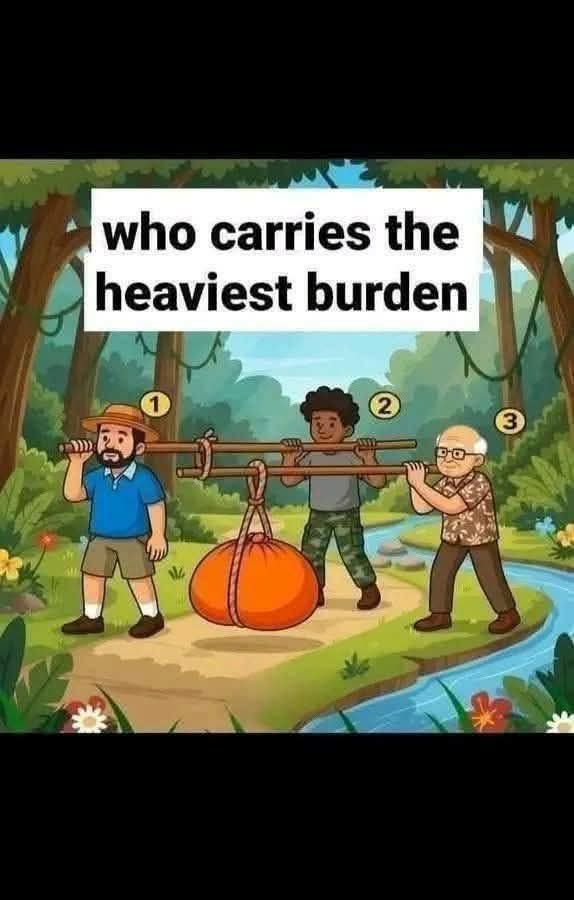
The forest path curved like a question mark, and the river beside it whispered answers no one asked out loud. Between them hung the sack—round, swollen, silent—swaying from the wooden poles like a heart outside a body.
People who passed them argued quietly about the same thing.
“It’s clearly number two,” someone said. “The weight hangs closest to him.”
“No,” another insisted. “Look at number one—he’s holding the pole on his shoulder. That strain goes straight to the spine.”
An old woman shook her head. “You’re all wrong. Number three is weakest. Burdens feel heavier when your body has lived longer.”
The three men never joined the debate.
Number One walked with his jaw tight, eyes forward. He had volunteered first. He was used to being the one who stepped up, the one people expected strength from. Every few minutes, his shoulder burned, but he told himself pain was proof of usefulness.
Number Two stayed quiet in the middle. The sack hung closest to him, brushing his knees with every step. He adjusted his grip often, not because it hurt most—but because if he loosened even a little, the others would feel it instantly. He carried not just weight, but balance.
Number Three breathed hard. His hands trembled around the pole. He had joined them late, afraid he would slow them down.
Every step reminded him of years behind him instead of ahead. Still, he kept walking, because turning back felt heavier than moving forward.
Then, without warning, the rope creaked.
The sack dipped sharply.
All three froze.
In that moment, something strange happened.
Number One felt fear—not of pain, but of failure. Number Two felt responsibility tighten like a knot. Number Three felt resolve harden where doubt used to live.
They adjusted together. No words. Just instinct.
The load steadied.
And for the first time, they looked at each other and laughed—not because it was easy, but because it wasn’t crushing them anymore.
That’s when the truth became clear.
The heaviest burden wasn’t on any single shoulder.
It was the silence, the assumptions, the belief that suffering could be measured from the outside.
Because weight changes. Strength shifts. And sometimes, the one who looks strongest is just hiding the ache better.
They kept walking.
Not because the burden grew lighter— but because they finally carried it together.